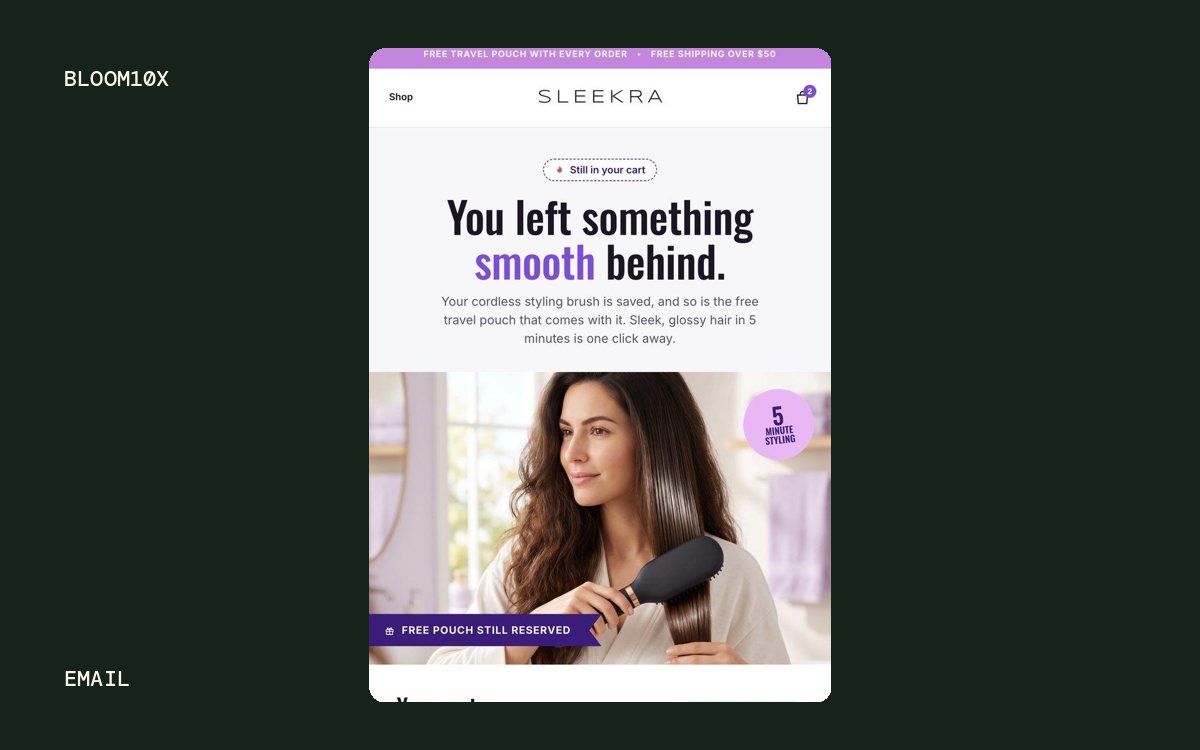
- Send 2 to 3 messages, starting 2 to 4 hours after checkout starts, each built around the exact products left behind.
- Hold any discount for the last message, and only for people who have never bought from you.
- Fix the reasons people leave on the site first, then judge the flow on recovered revenue and placed order rate.
An abandoned cart email goes to a shopper who added a product to their cart or started checkout and didn't buy. It usually runs as a series of 2 to 3 messages that bring the person back to the same cart. This article covers why carts get abandoned, the three types of abandonment flows, timing, what each email should say (with examples), discounts, SMS, and what to measure.
Why do shoppers abandon their carts?
Most carts never become orders. Baymard Institute's documented average cart abandonment rate is 70.22%, the unweighted average of 50 studies published from 2006 to 2025 (list updated October 2026).
Baymard's 2026 survey of 1,083 US online shoppers asked why they abandoned a purchase in the prior 3 months. The top answer, at 42%, was "just browsing / not ready to buy." The rest:
| Reason for abandoning (Baymard, 2026) | Share of shoppers |
|---|---|
| Extra costs too high (shipping, tax, fees) | 40% |
| Delivery was too slow | 20% |
| Didn't trust the site with card details | 19% |
| Had to create an account | 18% |
| Checkout too long or complicated | 17% |
| Site had errors or crashed | 17% |
| Return policy wasn't satisfactory | 13% |
| Couldn't see total order cost up front | 12% |
An email can only fix part of that list. It works on the "not ready yet" group and on doubts you can answer in writing: returns, delivery times, reviews. It can't fix a surprise shipping fee or a broken checkout. Those you fix on the site, which is the job of a funnel leak checklist.
Abandoned cart vs abandoned checkout vs browse abandonment
People use "abandoned cart" for three different flows. Each one starts from a different event and needs different data.
| Flow | Starts when | Data you need | Intent |
|---|---|---|---|
| Browse abandonment | Someone views a product and leaves | A known email plus product-view tracking | Low |
| Abandoned cart | Someone adds to cart but doesn't start checkout | A known email plus add-to-cart tracking | Medium |
| Abandoned checkout | Someone enters contact details at checkout and doesn't pay | The email or phone typed into checkout | High |
All three only work on people you can identify. An anonymous visitor who adds to cart and leaves can't be emailed.
Shopify's built-in abandoned checkout emails
Shopify covers the highest-intent group out of the box. The Shopify Help Center (2026) counts a checkout as abandoned when it stays incomplete for more than ten minutes after the customer gives their email. You switch it on under Apps, then Messaging, and choose who gets it and how long after abandonment it sends.
A Klaviyo abandoned cart flow
A Klaviyo flow adds more messages, branching and SMS. Klaviyo's guide recommends running two separate flows: one triggered by Started Checkout and one by Added to Cart. On Shopify, the Added to Cart event needs the "Track behavioral events" setting turned on. Add a filter of Started Checkout zero times since starting this flow to the Added to Cart flow so nobody gets both. Browse abandonment runs off the Viewed Product event.
Once the Klaviyo flow is live, turn off Shopify's emails so nobody gets two reminders for one cart.
How many abandoned cart emails should you send, and when?
Send 2 to 3 messages. Klaviyo's Help Center (updated October 2026) reports, based on its ecommerce customers, that 2 to 3 messages perform best. It recommends the first message 2 to 4 hours after someone starts checkout (its pre-built flow defaults to 4 hours) and a second one 20 to 48 hours later. Give big-ticket products longer delays, because people take longer to decide on a mattress than on socks.
Here is how a made-up skincare brand, Demo Brand, would set up its checkout flow:
| Step | Delay | Audience | Purpose |
|---|---|---|---|
| Email 1 | 4 hours after checkout started | Everyone | Reminder with the cart contents |
| Email 2 | 24 hours after email 1 | Everyone | Answer the common doubts |
| Email 3 | 48 hours after email 2 | Split: new vs past customers | Last call, discount for new customers only |
One filter matters more than any copy: Placed Order zero times since starting this flow. Klaviyo checks it before every message, so a shopper who buys after email 1 never gets email 2.
What should each abandoned cart email say?
Keep each email about the products left in the cart. Klaviyo's guidance is to show only the abandoned items (image, title, quantity, price) and a button back to the cart, and to leave out other products that pull attention away from checkout.
The three examples below are written for Demo Brand, a made-up brand. Its shopper, Sam, left a $24 Daily Cleanser in checkout.
Email 1: the reminder
Subject: Your Daily Cleanser is still in your cart Preview: Pick up where you left off.
Hi Sam,
You left the Daily Cleanser in your cart. We saved it for you.
[Product image, name, quantity, $24] [Return to your cart]
Not sure it suits your skin type? Reply to this email and a real person on our team will answer.
No discount, no countdown. Many people in this group just got interrupted.
Email 2: answer the doubts
Subject: A few things people ask before buying Preview: Shipping, returns and what customers say.
Hi Sam,
Still thinking it over? Here's what most people want to know first:
- Shipping: free on orders over $50, delivered in 3 to 5 business days.
- Returns: 30 days, even if you've opened it.
- What customers say: "Gentle enough to use twice a day." (Jordan, verified buyer)
[Return to your cart]
Extra costs, delivery speed, trust and returns are all on Baymard's list of reasons people leave, so this email answers them with your store's real policies and reviews.
Email 3: last call
Subject: Last reminder about your cart Preview: Your cart won't stay saved forever.
New customers get a code:
Your Daily Cleanser is still waiting. If you'd like to try it, use FIRST10 for 10% off your first order. The code expires in 48 hours.
[Return to your cart]
Past customers get the same email without the code.
When should you use a discount in an abandoned cart email?
Not in the first email. Klaviyo warns that a coupon in the first message can train customers to abandon carts on purpose, and that the discount is often unnecessary. Its recommendation is to wait until the final message, or to offer it only to people who have never bought, using a split in the flow.
Do the margin math before you pick the number. Demo Brand's $24 cleanser has a $9.60 product cost. A 10% code gives away $2.40 of a $14.40 gross margin, a sixth of the profit on the order. That's worth it for a first purchase that may turn into a repeat customer. It isn't worth it for a loyal customer who would have come back anyway.
Should you add SMS to your abandoned cart flow?
Yes, if you have proper consent. SMS reaches people fast, but the rules in the US are stricter than for email. Klaviyo's summary of US guidelines for SMS cart abandonment flows (updated July 2025) lists these as required by the TCPA, the CTIA or the carriers:
- Double opt-in turned on for SMS subscribers
- Express consent that covers both SMS marketing and cart reminders, mentioned in your sign-up disclosure
- Only 1 SMS per recipient in a cart abandonment flow
- The SMS sent within 48 hours of the triggering event
- Disclosures in your mobile terms of service and privacy policy
Timing rules apply too. Under the TCPA, marketing texts can't go out before 8 a.m. or after 9 p.m. in the recipient's time zone, and some states are stricter. Florida's mini-TCPA narrows the window to 8 a.m. to 8 p.m. Turn on quiet hours in your flow settings.
Klaviyo suggests launching the email-only flow first and adding SMS after you've confirmed it works. A Demo Brand text, sent about an hour after email 1:
Demo Brand: Your Daily Cleanser is still in your cart. Finish checkout here: [link]. Reply STOP to opt out.
Have your own counsel review your consent language.
What should you measure?
Track these four numbers for each flow, and for each message inside it:
| Metric | What it tells you |
|---|---|
| Recovered revenue | Sales from people who came back through the flow |
| Placed order rate | Share of recipients who placed an order |
| Revenue per recipient | Recovered revenue divided by people who got the message |
| Unsubscribe rate | Whether the timing or tone is pushing people away |
If you use Shopify's emails, its abandoned checkouts email report shows the sessions, orders and sales they drove.
Be careful with the headline number. Some people who get a reminder would have bought anyway. If your platform can split flow entrants at random, hold back a small group that gets no messages for a few weeks. The gap in placed order rate between the two groups is what the flow really adds.
How to reduce cart abandonment before the email
The flow catches people after they leave. Fewer people leave when the checkout is easier. Baymard's research points to fixes you control: show the full cost early, offer guest checkout, and cut form fields. The average US checkout shows 23.48 form elements by default, against 12 to 14 in an ideal flow.
Start there, then tune the emails. Running the flows, the testing and the reporting is what our retention work covers.
Frequently asked questions
What is a good abandoned cart email sequence? Two or three messages: a reminder 2 to 4 hours after checkout starts, a second 20 to 48 hours later that answers common doubts, and an optional last call.
Should I use Shopify's abandoned checkout emails or a Klaviyo flow? Shopify's built-in email is a fine start. A Klaviyo flow adds more messages, branching, SMS and an Added to Cart flow. Run one of them for checkouts, not both.
Should the first abandoned cart email include a discount? No. Save any discount for the last message and limit it to first-time buyers, so regular customers don't learn to wait for a code.
Can I send abandoned cart texts to anyone who gave a phone number at checkout? No. In the US you need express consent that covers marketing texts and cart reminders, collected through double opt-in, and you can send only one SMS per cart within 48 hours.

Michael Bui founded and runs BLOOM10X, a growth agency for ecommerce brands on Shopify. About BLOOM10X