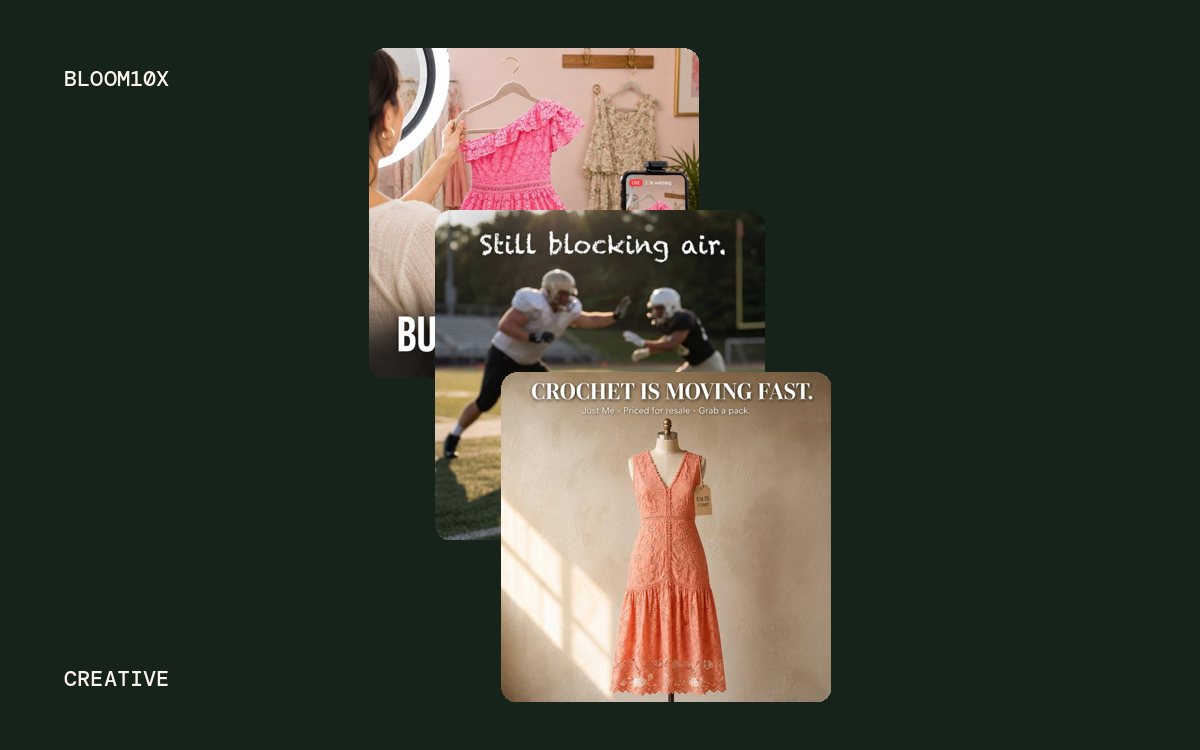
- Ad fatigue shows up as rising frequency, falling CTR and a climbing cost per purchase on the same ad, and Meta flags it in the Delivery column as Creative limited or Creative fatigue.
- Before you blame the creative, rule out the offer, the landing page, the season and tracking, because those break every ad at once.
- The fix is a steady testing rhythm of new concepts each week, plus new hooks on proven winners, not new colors on the same ad.
Ad fatigue is when the same people see your ad too many times and stop responding: cost per purchase rises, click-through rate falls and frequency keeps climbing. Meta calls the same thing creative fatigue and flags it inside Ads Manager. This article covers how to spot it, how to tell it apart from a bigger problem, and the testing rhythm that keeps it from coming back.
What is ad fatigue?
Take Demo Brand, a made-up skincare store spending $1,000 a day on Meta. Its best ad, a creator video about a night cream, brings in purchases at $30 each in week one. By week four the same ad costs $48 per purchase. Nothing else changed. The audience has simply seen it enough times that most people scroll past.
Meta's own definition matches. Its help page on creative fatigue (Meta Business Help Center, 2026) describes creative fatigue as an audience seeing the same creative too many times, which makes people less likely to engage and pushes up cost per result. "Ad fatigue" and "creative fatigue" mean the same thing in practice. "Facebook ad fatigue" is the same problem on Meta's placements.
What are the signs of ad fatigue?
Fatigue is a pattern across four numbers on the same ad, moving in the same direction over the same weeks. One bad day is noise.
| Signal | Where to see it in Meta Ads Manager | What fatigue looks like |
|---|---|---|
| Frequency | Ads tab, Performance columns, or add the Frequency column | Climbing week over week on the same ad |
| CTR (link click-through rate) | Customize columns, add CTR (link) | Falling while frequency rises |
| CPM | Same column set | Often flat or rising; people still see the ad, they just ignore it |
| Cost per purchase | Results and Cost per result columns | Rising steadily over several weeks |
| Delivery status | Delivery column on the ad set or ad | "Creative limited" or "Creative fatigue" |
Frequency
Meta defines frequency (Meta Business Help Center, 2026) as the average number of times each account saw your ad, calculated as impressions divided by reach. The same page says frequency may average 1 to 2 per ad set, or run much higher, depending on budget, audience size and schedule, and that if performance drops as frequency rises, your audience may be experiencing ad fatigue.
There is no single safe frequency number. A retargeting ad set aimed at 20,000 recent visitors will run a far higher frequency than a broad prospecting campaign, and that can be fine. What matters is the trend on each ad, read next to its CTR and cost per purchase.
Meta's Creative limited and Creative fatigue statuses
Meta now tells you directly. Per its creative fatigue help page (Meta Business Help Center, 2026), the Delivery column shows:
- Creative limited when cost per result is higher than ads you ran in the past but less than twice as much.
- Creative fatigue when cost per result is twice as much or more than ads you ran in the past.
Meta counts all recent exposures of the image or video, including from other campaigns run from your Page. It can also warn you before you publish if fatigue is likely in the first 7 days. Two limits: the feature only works for ad sets with one creative, and it excludes Advantage+ catalog ads, dynamic creative and Advantage+ app campaigns. If your ad sets hold five ads each, you will not see the status, so you still need to read the numbers yourself.
Meta's Account insights page in Ads Reporting (Meta Business Help Center, 2026) adds an account-wide view: how many active ads are fatigued, by format, plus a "creative similarity" insight that flags ads whose images or videos look too alike. Meta notes that similar creative can itself lead to fatigue. The feature may not be in every account yet.
To read the trend, open the ad level in Ads Manager, set the date range to the last 7 days, then compare it with the 7 days before. If one ad's frequency is up, its CTR is down and its cost per purchase is up while the account's other ads hold steady, that ad is tired.
Is it ad fatigue or a bigger problem?
This is where most accounts lose time. Fatigue hits one ad at a time, gradually. A problem with the offer, the site, the season or tracking hits every ad at once: six ads do not tire on the same day. Check these before you rebuild your creative.
| What you see | Likely cause | What to check |
|---|---|---|
| Every ad's cost per purchase jumps on the same day | Site, tracking or offer change | Shopify orders, recent theme or app changes, Events Manager |
| CTR holds but conversion rate drops | Landing page or offer | Product page speed, price change, stock, discount ending |
| Costs rise across the account during peak shopping weeks | Seasonality | The same dates last year |
| Meta reports fewer purchases but Shopify orders are steady | Tracking | Pixel and Conversions API events, deduplication |
| New ads fail as fast as old ones | Offer or product-market fit | The offer itself, not the creative |
Meta's own recommendations for fatigued ads also include expanding the audience (Meta Business Help Center, 2026) so the ad reaches people who have not seen it too often. That helps when an ad set is boxed into a small audience. It does not help when the creative is the problem.
How do you fix ad fatigue?
You fix it by giving the audience something new to look at on a schedule, before costs climb. Pausing the tired ad and duplicating it does not count.
Test new concepts, not new colors
Meta's fatigue page recommends a new image or video that is materially different from the original. A new background color or a different font is not materially different. To the viewer it is the same ad.
A new concept changes the angle, the person, or the format. For Demo Brand's night cream, three different concepts could be:
- A creator's 30-day before and after, filmed on a phone.
- A founder talking through the one ingredient competitors leave out.
- A static image comparing the price per use against two well-known brands.
Each one gives a different reason to buy, aimed at a different buyer. That is what resets attention.
Iterate on winners
When a concept wins, get more out of it before it tires:
- New hooks. Re-cut the first three seconds with a different opening line, shot or caption. The body of the ad stays the same. Read our guide to hook rate to see which openings hold attention.
- New creators on the same script. The same message from a different face reaches people the first creator did not.
- New formats. Turn the winning video into a static, a carousel, or a shorter cut for Stories and Reels.
Meta's fatigue page also notes that keeping the original ad active, rather than pausing it, may get you more results. Add new ads next to the winner instead of replacing it the day costs tick up.
Use a simple testing structure
You do not need a complex setup. A structure that works for most Shopify brands spending $20,000 to $100,000 a month on Meta:
- One testing campaign with its own budget, where new ads launch each week.
- One scaling campaign where proven winners run with most of the budget.
- A fixed weekly batch of new ads: a few new concepts, plus new hooks on the current winners.
- One decision rule set before launch. For example: give each new ad enough spend to buy at least two purchases at your target cost, then keep it if it beats the average, cut it if it does not.
Worked example for Demo Brand (made-up numbers): at $30,000 a month and a $30 target cost per purchase, it puts $4,500 a month into testing. Each week it launches 3 new concepts with 2 hooks each, 6 ads in all. Each ad gets about $60 to $120 before a keep or cut decision. Winners move to the scaling campaign with new hooks queued behind them.
How many new ads a month you need depends on spend. Our creative volume calculator estimates it from your monthly budget.
A steady rhythm shows up in the numbers over time. Wholesale Fashion Trends cut cost per purchase from $37.10 to $21.19 (Meta-reported, Jun 1 to Sep 26, 2026 vs the same dates in 2025) while testing creator videos and statics on a schedule.
Plan production a month ahead
Fatigue is predictable, so production can be too. Look back at how long your winning ads lasted before their cost per purchase started to climb, and have the next batch filmed and edited before the current one reaches that age. Brands that wait for the "Creative fatigue" status to start filming keep paying for tired ads while the next batch is made. If you would rather hand that pipeline to a team, see how our creative service runs it.
Frequently asked questions
What is the difference between ad fatigue and creative fatigue? None in practice. Both describe an audience seeing the same ad too often and responding less. Meta uses "creative fatigue" in Ads Manager.
What frequency is too high on Facebook ads? There is no single number. Meta says (2026) frequency may average 1 to 2 per ad set or run much higher depending on budget, audience size and schedule. Watch the trend: rising frequency with falling CTR and rising cost per purchase on the same ad points to fatigue.
Why don't I see the Creative fatigue status in my account? Meta only shows it for ad sets with one creative, and not for Advantage+ catalog ads, dynamic creative or Advantage+ app campaigns. Ad sets with several ads need to be checked by hand.
Should I pause an ad when it shows Creative limited? Not right away. Add new, materially different ads next to it and let them take over spend. Meta notes that keeping the original active may get more results.
How often should a Shopify brand launch new ads? Weekly is a sensible default for brands spending five figures a month on Meta, with the batch size set by spend. The creative volume calculator gives a starting estimate.

Michael Bui founded and runs BLOOM10X, a growth agency for ecommerce brands on Shopify. About BLOOM10X