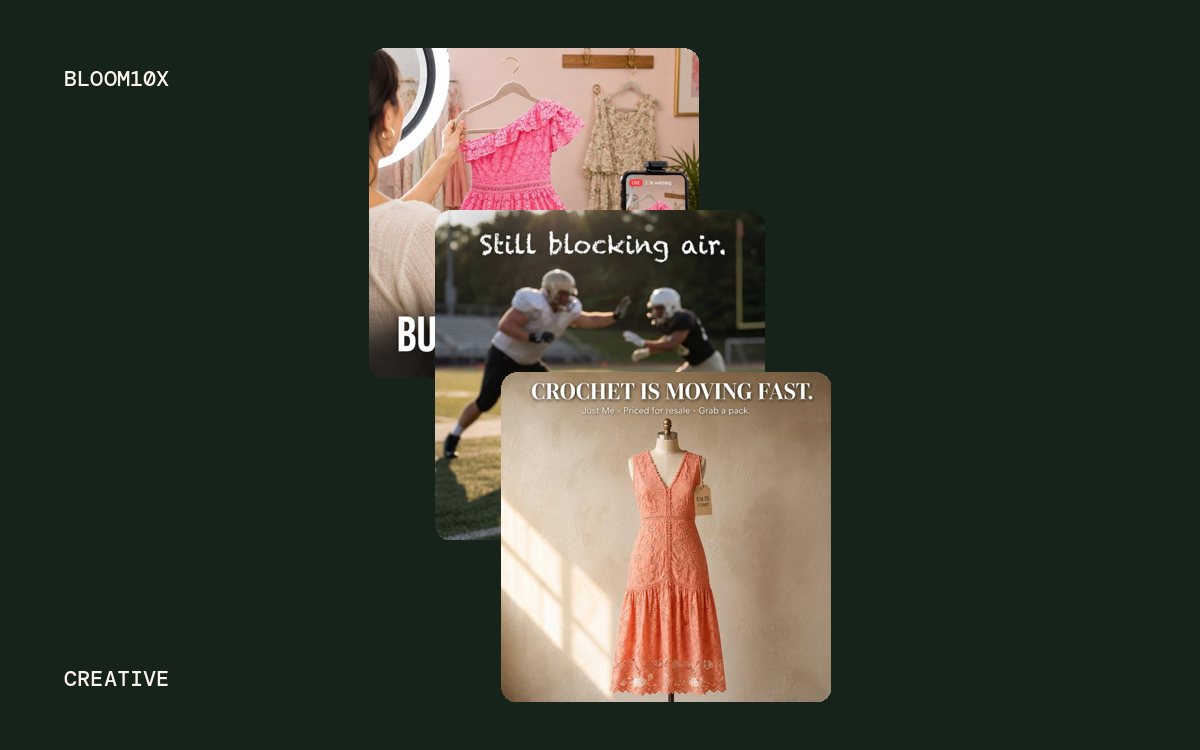
- Static ads are single images, so they are fast to make and cheap to test: use them for offers, comparisons and proof, and use video when the product has to be seen in use.
- Build to Meta's specs: 4:5 at 1440 x 1800 px for Feed, 9:16 at 1440 x 2560 px for Stories and Reels, with the top 14% and bottom 35% kept clear of text.
- Judge statics on link click-through rate and cost per purchase. Hook rate and hold rate are video metrics and do not apply.
Static ads are single-image ads, with no video or motion, that run in feed, Stories and Reels placements on Facebook and Instagram. For a Shopify brand they are the fastest ad to make and the cheapest to test, so a well-run account keeps them in rotation next to video. This article covers when statics beat video, the formats that sell, Meta's published specs, and how to test and read the results.
What is a static ad?
A static ad is one image plus the copy around it: primary text above, headline and call-to-action button below. On Meta, one ad can serve Facebook Feed, Instagram Feed, Stories, Reels and Marketplace if you upload the right sizes.
The image has under a second to do three jobs: stop the scroll, show what the product is, and give one reason to tap. If it needs to do more than that, the idea probably wants to be a video.
When do static ads beat video?
Statics win when the message fits in one glance. Video wins when the product has to be seen working.
| Statics usually win | Video usually wins |
|---|---|
| An offer with a clear number: bundle, discount, free gift | A product that needs a demo: texture, fit, how it works |
| A comparison against the usual alternative | A result that happens on camera over time |
| Proof you can screenshot: reviews, ratings, press | A founder or creator telling a story |
| Retargeting people who already know the product | Cold audiences who have never seen the brand |
| You need ten new ads this week | The idea depends on sound or pacing |
Two more reasons to keep statics in the account. They are cheap to produce, so the same budget tests more angles, and a winning angle from a static becomes the brief for the next video. They also deliver the whole message with the sound off and half a second of attention.
Statics lose on products whose value is invisible in a still frame: a blender, a stain remover, leggings that only look good when someone moves. If the honest pitch is "you have to see it," shoot the video.
Which static ad formats work for ecommerce?
Product and benefit callout
The product on a clean background with three or four short labels pointing at the parts that matter: "Leak-proof lid." "Fits a cup holder." It reads like a labelled diagram. Use it for products where buyers check a specific feature before they buy.
Comparison or us vs. them
Two columns, your product against the usual alternative, with ticks and crosses. Name the category, not a competitor: "drugstore serum," "fast-fashion tee." The buyer is already comparing in their head, and the ad does the work for them.
Testimonial or review screenshot
A real review with the star rating and first name, laid out like a screenshot or a text message. Pick reviews that name a specific problem solved over ones that say "love it." Only run reviews you have permission to use.
Offer
The deal is the headline: "Buy 2, get 1 free" or "Free shipping over $50." Product in frame, price math obvious, conditions small but readable. Best for promotions and for retargeting people who have already visited.
"Ugly" or native-looking
A phone snapshot, a sticky note, handwritten text, a notes-app screenshot. It looks like a post from a friend, so people read it before they decide it is an ad. Open with the line your buyer would use to describe their own problem.
Before and after
The messy drawer and the organized one, the stained rug and the clean one. Strong for home, cleaning and organization products. In health, weight loss and cosmetics it is restricted: Meta's Health and Wellness advertising policy limits these ads, for example cosmetic before-and-after ads must target people 18 or older. Read the policy before you build one.
Listicle
"4 reasons people switch to Demo Brand socks," numbered over a product photo. A list gives the scroller a reason to stop and read, and each point becomes a separate ad to test later.
What sizes should static ads be?
Meta's Ads Guide lists a recommended ratio and resolution per placement. Upload all three versions and Meta serves the one that fits.
| Placement | Ratio | Recommended size | Source |
|---|---|---|---|
| Facebook and Instagram Feed | 4:5 | 1440 x 1800 px | Meta Ads Guide: Facebook Feed image |
| Stories and Reels | 9:16 | 1440 x 2560 px | Meta Ads Guide: Instagram Stories image, Instagram Reels image |
| Carousel cards | 1:1 | at least 1080 x 1080 px | Meta Ads Guide: Facebook Feed carousel |
The same Facebook Feed page lists the other limits: JPG or PNG, 30MB maximum, 600 px minimum width, primary text of 50 to 150 characters and a headline of 27 characters.
Safe zones for 9:16
For Stories and Reels images, Meta's guide says to leave roughly 14% of the top, 35% of the bottom and 6% of each side free of text, logos and key elements, because the profile icon and call-to-action button sit there. On a 1440 x 2560 image that works out to about the top 360 px, the bottom 900 px and 86 px on each side.
In practice, design the 9:16 version on its own. Stretching the 4:5 layout puts the headline under the profile icon and the price under the button.
How many static ads should you test?
Enough to find the next winner before the current one wears out, and few enough at a time that each ad gets real spend. Two limits decide the number.
- Spend per ad. Meta says an ad set becomes learning limited when it is unlikely to get about 50 optimization events in the week after a significant edit, and it lists running too many ads at the same time as one cause (Meta: About Learning Limited). Six ads that each get meaningful spend teach you more than twenty that get crumbs.
- Volume per month. Higher spend wears creative out faster, so it needs more new ads. The creative volume calculator works out how many new ads a month your spend calls for.
Test angles, not colors. Our working rule: one batch is one angle, for example the comparison, built three to five ways with a different headline, image or layout. If the batch wins, make more of that angle. If every version loses, the angle lost, and changing the font will not save it.
A schedule matters more than any single ad. Wholesale Fashion Trends cut cost per purchase from $37.10 to $21.19 (Meta-reported, Jun 1 to Sep 26, 2026 vs the same dates in 2025) while testing creator videos and statics on a schedule.
How do you read static ad results?
Hook rate and hold rate do not apply. Both are built on 3-second video plays and ThruPlays, and a still image has no plays. (The hook rate guide covers those for your video ads.) Read statics on these:
| Metric | What it tells you |
|---|---|
| Link click-through rate (CTR) | Did the image and headline earn the tap? |
| CPM | What the auction charged to show the ad |
| Landing page conversion rate | Did the page deliver what the ad promised? |
| Cost per purchase | Which ad makes money. This picks the winner. |
Example: Demo Brand (made-up numbers). Demo Brand spends $1,000 on each of two statics at a $20 CPM, so each gets 50,000 impressions.
| Ad A: review screenshot | Ad B: offer | |
|---|---|---|
| Spend | $1,000 | $1,000 |
| Link CTR | 1.6% | 1.0% |
| Link clicks | 800 | 500 |
| Purchases | 20 | 25 |
| Conversion rate | 2.5% | 5.0% |
| Cost per purchase | $50 | $40 |
Ad A wins on CTR. Ad B wins on money. The review earns curious clicks from people who were not ready to buy, while the offer filters for buyers before they tap. Keep Ad B. Ad A's gap between clicks and purchases says the page did not finish the job the ad started, so test the same review on a page that leads with it.
Two habits keep the read honest. Compare Meta-reported purchases with Shopify orders for the same dates, because platforms tend to over-claim. And let each ad collect enough purchases to separate it from your current best before you call it; a day of CTR picks the wrong ad.
Static ad checklist
- One message per image. If the image needs a sentence of explanation, cut it down.
- Product visible and recognizable at thumbnail size.
- Headline readable on a phone at arm's length.
- Three files per ad: 4:5 at 1440 x 1800 px, 9:16 at 1440 x 2560 px, 1:1 at 1080 x 1080 px or larger for carousels.
- On 9:16, nothing important in the top 14%, bottom 35% or outer 6% on each side.
- Headline of 27 characters or fewer, primary text of 50 to 150 characters.
- Every claim backed up, every review used with permission, restricted categories checked against Meta's policy.
- One angle per batch, three to five versions.
- Winner picked on cost per purchase and checked against Shopify orders.
If you want statics and creator video produced and tested on a schedule, see how our creative service runs it.
Frequently asked questions
Are static ads still worth running on Meta? Yes. They are the cheapest way to test a new angle, and they carry offers, comparisons and proof as well as video does. Run them next to video and let cost per purchase decide the budget split.
Do static ads run in Reels? Yes. Meta's Ads Guide lists image ads for Instagram Reels at 9:16 and 1440 x 2560 px. Keep text out of the bottom 35%, where the caption and button sit.
What is the best size for a static ad on Facebook and Instagram? 4:5 at 1440 x 1800 px for Feed, which is Meta's recommendation. Add a 9:16 version for Stories and Reels and a 1:1 version for carousels.
How long should a static ad run before I judge it? Until it has enough purchases to compare against your current best ad. Judging on a day of CTR usually rewards the most clickable ad, not the most profitable one.

Michael Bui founded and runs BLOOM10X, a growth agency for ecommerce brands on Shopify. About BLOOM10X