- AOV is revenue divided by orders, and the main levers are bundles, a free-shipping threshold, quantity breaks, well-timed upsells and a higher-value hero offer.
- Set the free-shipping threshold from your own order data, so one add-on gets most near-miss orders over the line.
- Judge every AOV change on revenue per visitor, because a higher AOV with a lower conversion rate can lose money.
Average order value (AOV) is your revenue divided by your number of orders. You raise it with five levers: bundles, a free-shipping threshold, quantity breaks, upsells and cross-sells shown at the right moment, and a higher-value hero offer. This article covers each lever with a worked example, how to set a free-shipping threshold, when a higher AOV hurts, and how to test changes properly.
What is average order value?
AOV is the average amount a customer spends per order. Shopify's analytics reference defines it as (gross sales minus discounts) divided by orders, excluding returns and edits made after the order.
A worked example: Demo Brand, a made-up skincare brand, takes $50,000 from 1,000 orders in a month. Its AOV is $50.
Why does a higher AOV matter?
Most of your costs per order don't grow with the order. Shipping, packing and payment fees are similar for a $50 order and a $65 order, and so is the ad cost to get the customer to check out.
Here is Demo Brand's math, with a 60% product margin and $10 of shipping and fulfillment per order:
| AOV $50 | AOV $65 | |
|---|---|---|
| Gross profit on products (60%) | $30 | $39 |
| Shipping and fulfillment | $10 | $10 |
| Profit per order before ads | $20 | $29 |
| Break-even ROAS | 2.5 | 2.24 |
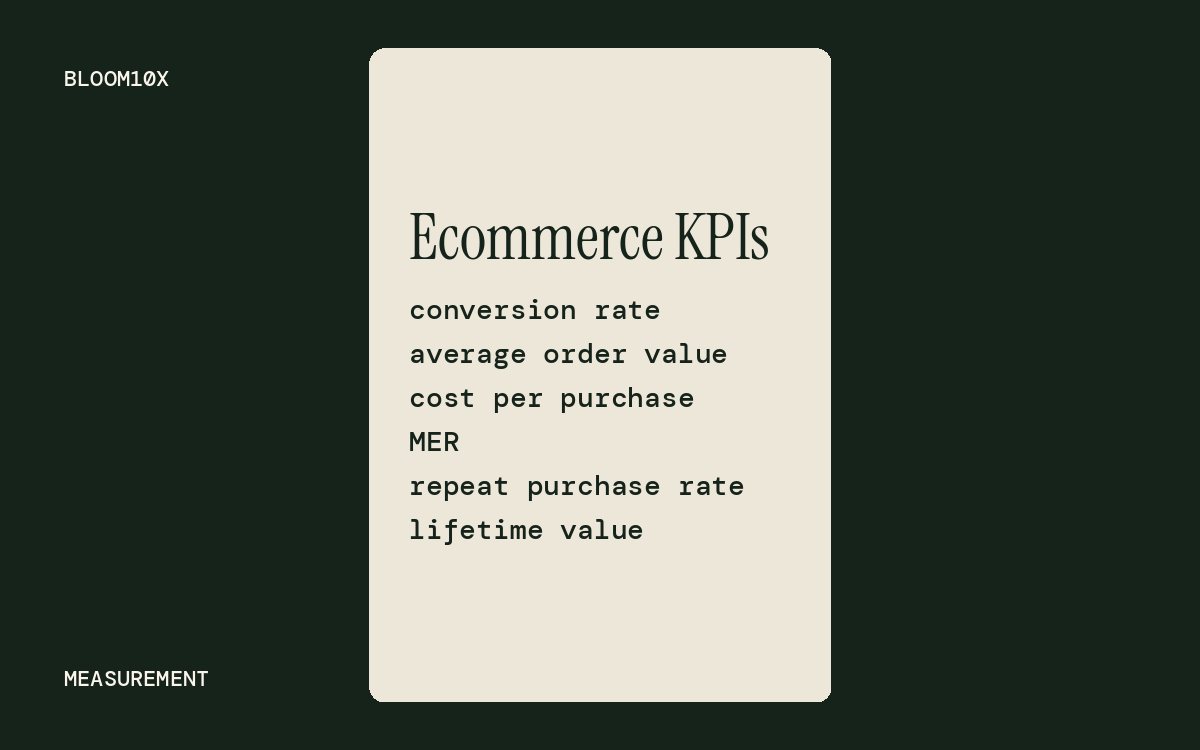
The same ads now have more room to work. At $65 the brand breaks even at a lower return on ad spend, or it can pay up to $29 to win an order instead of $20. You can run your own numbers in the ROAS calculator. AOV is one of the core numbers in our guide to ecommerce KPIs.
The five ways to increase AOV
| Lever | Demo Brand example | Where it lives |
|---|---|---|
| Product bundles | $80 routine set (cleanser, moisturizer, serum) | Product and collection pages |
| Free-shipping threshold | Free shipping over $65 | Site banner, cart |
| Quantity breaks | Buy 2 save 10%, buy 3 save 15% | Product page |
| Upsells and cross-sells | Add the travel size from the cart | Product page, cart, post-purchase |
| Higher-value hero offer | Lead ads with the set, not the single cleanser | Ads and landing pages |
Product bundling
A bundle sells products that already go together at one price. Demo Brand sells a cleanser at $24, a moisturizer at $32 and a serum at $38, which adds up to $94. As an $80 routine set, the customer saves $14 and the brand sells three products in one order. With product costs at 40%, the set earns $42.40 in gross profit against $14.40 for the cleanser on its own.
Build bundles from your order data, not your guesses. Look at which products already appear together in orders, and bundle those first. Shopify's free first-party Shopify Bundles app handles fixed bundles (a set list of different products) and multipacks (several of the same product) from the admin.
Free-shipping threshold
Shipping cost is the most common fixable reason people leave. In Baymard Institute's 2026 survey of 1,083 US online shoppers, 40% said they had abandoned a purchase because extra costs such as shipping were too high. A threshold turns that cost into a reason to add one more item.
How to set it from your current AOV:
- Export the last 90 days of orders and group them by order value in $10 bands.
- Find the cluster of orders sitting just under a round number above your AOV.
- Check you have an add-on priced to close that gap.
- Check the gross profit on that add-on covers the shipping you'll now absorb.
- Show the gap in the cart: "You're $17 away from free shipping."
For Demo Brand, a large share of orders land between $45 and $50. A $17 travel-size cleanser takes a $48 order to $65, so the threshold goes at $65. The add-on earns $10.20 in gross profit, which covers the $8 average shipping cost the brand now pays. If your add-ons can't cover the shipping, raise the threshold or add a cheaper accessory first.
Quantity breaks
Quantity breaks reward buying more of the same product. They suit consumables people run out of: skincare, supplements, coffee, pet food.
For Demo Brand's $24 cleanser, with a $9.60 product cost:
| Offer | Revenue | Gross profit |
|---|---|---|
| 1 cleanser | $24.00 | $14.40 |
| 2 at 10% off | $43.20 | $24.00 |
| 3 at 15% off | $61.20 | $32.40 |
Each step gives away margin per unit and earns more profit per order. Keep the discounts small enough that the per-order profit still rises at every step.
Upsells and cross-sells at the right moment
An upsell offers a bigger or better version of the item. A cross-sell offers something that goes with it. The timing matters as much as the offer:
- Product page: one "pairs well with" product, close to the add-to-cart button. The moisturizer next to the cleanser.
- Cart: one add-on that closes the gap to free shipping.
- Checkout: keep it clean. Anything that slows payment costs you orders.
- After payment: the post-purchase offer, covered below.
Show one offer at each step, not a carousel of ten, so the customer has a single easy yes or no.
A higher-value hero offer
The product you lead with sets the order size. If every ad sends people to the $24 cleanser, most orders will be about $24. If the ads and landing page lead with the $80 routine set, and make the set the default choice, more first orders start at $80. The single cleanser stays available for people who want it.
This works best when the bundle solves the full problem the customer came with. "A complete morning routine" is an easier sale at $80 than three separate products adding up to $94. Wholesale Fashion Trends grew new-customer orders 42%, from 668 to 950 (Shopify, Jun 1 to Sep 27, 2026 vs 2025), after its offer, product pages and email flows were reworked alongside the ads.
Post-purchase upsells
A post-purchase upsell appears after the customer has paid, before the order confirmation page. Shopify's Help Center explains that these offers come from a checkout app that supports post-purchase features, and that a store can use only one such app on the post-purchase page at a time.
The upside is that the first order is already placed, so the offer can't cost you that sale. For Demo Brand, a customer who just bought the cleanser sees the serum at 15% off with one click to add it to the same shipment.
Keep the offer related, cheaper than the first order, and simple to accept. Measure the take rate and the added revenue per order, and watch refund requests for the add-on.
When does raising AOV hurt?
AOV also rises when small buyers stop buying. If a change pushes them away, AOV goes up while revenue goes down.
The number that catches this is revenue per visitor: conversion rate times AOV.
| Demo Brand | Conversion rate | AOV | Revenue per visitor | Revenue per 10,000 visitors |
|---|---|---|---|---|
| Current setup, free shipping over $65 | 2.0% | $50 | $1.00 | $10,000 |
| Threshold raised to $90 | 1.6% | $58 | $0.93 | $9,280 |
AOV rose $8 while revenue fell $720 per 10,000 visitors, because the higher threshold put off enough buyers to cancel out the bigger baskets. Steep minimums, heavy bundle pressure and pop-ups during checkout fail the same way.
How to test an AOV change properly
- Change one thing at a time. A new threshold and a new bundle in the same week leave you unable to say which one worked.
- Read revenue per visitor first, then AOV and conversion rate. Add gross profit per visitor if discounts are part of the change.
- Split traffic if you can. A proper A/B split beats a before-and-after comparison, which mixes in seasonality and changes in ad spend.
- Run whole weeks. Weekday and weekend shoppers behave differently, so include both.
- Check returns before calling it. A bundle that drives refunds is not a win.
Planning and running these tests is part of our conversion work.
Frequently asked questions
What is the formula for average order value? AOV equals revenue divided by number of orders. Shopify calculates it as (gross sales minus discounts) divided by orders, before returns and post-order edits.
What is the fastest way to increase AOV? For most Shopify stores, a free-shipping threshold set just above current AOV, with an add-on that closes the gap shown in the cart. It needs no new products.
Does product bundling increase average order value? Yes, when the bundle groups products customers already buy together and the bundle price still earns more profit per order than a single item.
Should I track AOV or conversion rate? Both, through revenue per visitor. A change can raise one and lower the other, and only revenue per visitor shows the net effect.
Do post-purchase upsells hurt conversion rate? They appear after payment, so they don't affect whether the first order happens. Keep them relevant and easy to decline so they don't hurt the customer's experience.

Michael Bui founded and runs BLOOM10X, a growth agency for ecommerce brands on Shopify. About BLOOM10X